

How Many Amps Does Amplifier Draw
Q: Where can I mount my amp?
A: Since space is at a premium in most vehicles, it's important to observe just the right spot to mount your amp. An amplifier needs some open air space around information technology to dissipate the heat that builds up as it works, otherwise it will overheat and shut down. Keeping that in mind, our ii favorite locations are under a seat or in the trunk. Under-seat mounting is space-efficient and keeps the amp hidden from view. It as well lets you run shorter cables from your receiver. A trunk-mounted amp requires longer power and signal cables, merely is safely subconscious and closer to rear speakers and your subwoofer.
Alert: removing your seat could deactivate your vehicle'southward SRS system.
back to acme
Q: My machine audio amplifiers all came with fuses. Why do I demand to add an additional fuse at the battery? And how big a fuse practice I demand?
A: The answers to most questions about fuses include the word "safety." While most car sound amplifiers practise come up with their own fuses, these fuses are designed to protect merely the amps themselves. You need to install a fuse at the battery to protect the power wiring, your car, and yourself confronting fire, in the event of a short circuit. The adjacent ii answers encompass this in greater detail.
back to top
Q: Why fuse at the bombardment?
A: In the event of an electrical mishap, you lot do not want a live wire stretching throughout your vehicle. Installing a fuse of the proper amperage on your power cable protects your auto and gear from the dangers of a curt circuit. A short circuit occurs when a positive current-bearing wire makes contact with bare metal (like your car chassis). Considering your unabridged car chassis tin can be considered "negative" or footing, you lot tin can think of a curt circuit as positive touching negative. Y'all definitely don't want this to happen, but if it does, a properly installed fuse will prevent a fire or other damage.
A fuse does its piece of work by "blowing" and stopping the period of current. A fuse is a lot easier and cheaper to replace than your car or your life. So, given the alternatives, "blowing a fuse" is a relatively good matter. You lot can optimize the protection your fuse provides past installing it as shut to the battery as possible — that increases the length of the protected cable behind it. 18 inches from the bombardment is the maximum distance we recommend.
[Learn more in our Power Wire Fusing article.]
back to top
Q: How big should the fuse be?
A: If you're installing just 1 amplifier, the fuse at the battery should simply match or slightly exceed the fuse rating of the amplifier itself. Some amps don't come up with onboard fuses — yous have to find their fuse ratings in their possessor'southward manuals. If you're installing 2 or more amplifiers, simply add their fuse ratings together and install a fuse rated roughly equal to this sum. Generally, information technology'southward better to go slightly college than lower, but a margin of v amperes is acceptable.
Say you have three amplifiers, two with fuse ratings of 20 amps each and ane with a fuse rating of 25 amps. In this case, you tin safely become with either a 60 or 70 amp fuse. Of course, if your system is powerful enough to demand that you install a heavy duty fuse, it's important that your ability and ground wire be of an appropriately heavy gauge as well.
dorsum to tiptop
Q: Exercise I need a separate fuse block also?
A: A safe system volition accept the right fuses installed at each amplifier and also on the ability cable by the battery. But if you've ever taken a peek at some multi-amp competition-style car sound systems, you lot may have noticed fuses at a third location — in a fuse cake past the amps. Sure this hardware looks skilful, only is it necessary?
If your amplifiers take on-board fuses, y'all don't need some other set. Just if your amplifiers don't each take their ain fuses, you lot definitely practise need to fuse each amp's power line nigh the amp. Ofttimes this is done with a fused distribution block, so each amp gets its power line fused as information technology's split off from the primary ability cable. This makes it so that if one amp suffers a catastrophic brusk circuit, for case, the damage will not spread to the other amps or your main power cable.
back to top
Q: What wiring exercise I need to hook upward my amplifier? Does any of it come with the amp?
A: Amplifiers by and large do not include the wiring necessary to hook them up. Nonetheless, nosotros offer a number of amp wiring kits that tin provide everything you demand to ship signal and ability to your amp.
You need a thick ability cable to run from your motorcar bombardment'south positive final, through the machine's firewall, all the way to the amplifier. The required thickness (approximate) of the power wire is determined past the amp'south manufacturer — you lot can look it upwards in the owner'south manual or online. Be sure to install an in-line fuse or excursion billow near the bombardment. Without one, an accidental short circuit could pose a burn down hazard and damage your amp (not to mention your car).
You also need another length of the same judge cable to serve as your ground wire. You won't need as long a basis wire considering your grounding signal should exist close to the amplifier. The point on your car'due south chassis where you commodities the ground wire should exist cleaned and scraped paint-free to ensure a tight electric connection.
The terminal wire you need for powering the amp is a turn-on lead. It doesn't need to be every bit thick equally the power and ground wires (xviii gauge should be fine). It runs from the remote plow-on lead at the back of your receiver to the remote terminal on the amp. In the case of a manufactory system with no remote connection, you lot can tie into a switched 12-volt source, one that only comes on with the car, in the fuse box.
The sound bespeak travels from the back of your receiver to your amplifier through an RCA patch cable. Your patch cable should exist long plenty to reach the amp but non then long that information technology has a lot of slack and could go kinked over fourth dimension. If you're using a factory receiver without RCA outputs, you can get your amp's input betoken from the manufactory speaker wiring, either behind the radio or from the rear speaker leads. Many amplifiers have loftier- or speaker-level inputs to accommodate this kind of setup. Otherwise, you tin apply a line output converter to catechumen the speaker-level signal down to the preamp/RCA level your amp'due south input needs.
At the other terminate of the amp, y'all'll need speaker wire. Generally 12, xiv, or 16 approximate wire should be sufficient. Keep in mind that current flows more easily through thicker wire. (The lower the guess number, the thicker the wire.)
dorsum to top
Q: What size power and ground wires practice I demand for my amplifier?
A: Your car amplifier will draw a lot of electric current from your vehicle's electric organisation, and therefore will demand thick plenty power wiring to ensure that the current flows freely, without resistance. This is important — otherwise, your amp can over-work, nether-perform, or even overheat and close downward. For a single amplifier install, the required wire size has been specified by the amp'due south manufacturer and tin be found in the owner'south manual or online.
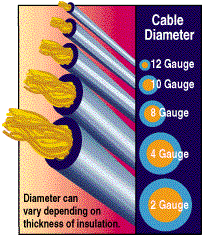
Using thicker power and ground cables will allow your amplifier to describe the juice information technology needs from the battery more easily.
If yous don't accept the manual, or plan a multi-amp system, you should check out our Cable Gauge Chart to determine the proper guess of wiring to utilise. Yous will be asked to supply the full RMS wattage of your arrangement, also as the estimated length of your intended power cablevision. By figuring in a typical amp's efficiency and the normal voltage of a running car, yous'll find out the maximum electric current the amp will draw from the electrical organization and exactly which size wire you'll demand so it will all work properly.
back to top
Q: What's this sparse blue wire for?
A: The sparse blue wire is called the turn-on pb, as it carries a indicate that turns on your amplifier. The turn-on pb runs betwixt the amp and your receiver. You wouldn't want your amp to be on all the time, draining your battery dead every time you park. The plough-on signal triggers an electronic switch within the amp that powers information technology on whenever the receiver turns on. The turn-on lead must exist connected properly in order for your amp to power up.
back to top
Q: How much air space do I need around my amplifier?
A: An amplifier produces estrus, which its heat sink absorbs and dissipates. You should get out a few inches of air infinite around each side of the amp so that it stays equally cool equally possible. When mounting an amp on a side wall (vertically), make sure that the fins on the heat sink are also running vertically so the estrus escapes more hands. Don't mountain an amp upside down — the amp will not be able to misemploy heat effectively, and overheating can impairment or destroy your amp.
back to superlative
Q: How practise I hook upwards multiple amplifiers?
A: You must supply power from your bombardment to every amplifier in your system. You could run a separate power wire to each amplifier, but a power distribution cake will give y'all a cleaner installation with less potential for noise problems.
Let's say that you desire to install a 200-watt mono subwoofer amp, a 75W ten 4 amp for your door and rear deck speakers, and a 30W ten ii amp for your dash speakers — 560 watts of total system power. Run a single iv-gauge power wire from your battery to a iii-manner (or 4-mode) distribution block side by side to your amps. From the block, 8-guess cables supply ability to your subwoofer and multi-channel amplifiers, while a x-gauge wire feeds the xxx x 2.
Ground your amplifiers in reverse fashion — one x-gauge and ii 8-gauge footing cables run from the three amplifiers to a 3-way grounding block. Then, a 4-gauge ground cable connects the grounding block to your vehicle'south chassis.
In multi-amp systems, the remote turn-on output of the receiver could get overwhelmed and fail. In that state of affairs, you'll need a relay on the plow-on pb that gets triggered past the receiver but gets the 12-voly turn-on signal from somewhere else, like the fuse box.
Normally you utilize RCA patch cables to send the point from your receiver to your amplifiers. A receiver with 3 sets of preamp outputs can provide indicate for your front, rear, and subwoofer amps. If your receiver has but one set of preamp outputs, you'll take to use Y-adapters to provide bespeak to a multi-amp set, or use amps with built-in preamp outputs that let yous to daisy chain the signal from ane amp to the next.
back to top
Q: My amplifier is hooked upward, but it won't plough on. What's wrong?
Check (and repair if necessary) the following:
- Do all the other electrical systems in the car piece of work?
- Is the receiver turned on?
- Are the on-lath fuses in the amp proficient?
- Is the in-line fuse on the power cable most the bombardment skilful?
- Is the power cablevision from the auto bombardment to the amp firmly connected at both ends?
- Is the ground cable from your amp firmly connected to the car's metal chassis with no paint or varnish interfering with a make clean electrical contact?
- Is the plow-on atomic number 82 (ordinarily blue) to the amp from the receiver properly connected? (Set the receiver to the tuner or radio mode. If your amp now comes on, it means the plow-on atomic number 82 was wired to the receiver'south power antenna lead by mistake and needs to be correctly re-wired to the remote turn-on lead connection.)
- If this is a multi-amp system, have you tried powering upwardly just one amp at a time? (The turn-on signal has a limited capacity. In multi-amp systems it is oft necessary to use the turn-on signal from the receiver to ability a relay, which in turn supplies the turn-on signal to the amps from another ability source.)
If the answer to all those questions was yes and your amp withal doesn't come up on, then perform the following test:
- Remove the in-line fuse on the power cablevision.
- Disconnect the plough-on pb from the amp and tape the end and so information technology tin't contact any metal.
- Have a short length of wire and connect it between the amp's remote turn-on concluding and its positive power terminal, leaving the ability cable continued to the amp.
- Supplant the ability fuse.
- If the amp now comes on, the turn-on lead wire, or the signal itself, from the receiver is bad and should exist repaired. Replacing the turn-on lead commonly fixes this. Otherwise you'll need to provide that signal (+12 volts DC) from somewhere else, like the machine's fuse box which only gets powered when the ignition's on. Y'all do not want to go out the turn-on lead jumped to the amp's positive final because that way the amp will never shut off, draining your car's battery dead.
- If the amp did not turn on, you most likely have a damaged amp and need to replace information technology or contact your dealer to arrange for its repair.
- One final check, if you lot have and know how to use a voltmeter, while that remote jumper wire is still fastened, measure the voltage at the amplifier'southward power terminal and remote turn-on terminal. If information technology reads about +12 volts DC or more each, then your wiring is adept but your amp is bad. If you don't become the right voltage at the amp, then yous know to keep looking for a wiring problem.
Important Annotation: For your personal safety, and that of your equipment, always remember to remove the ability fuse earlier disconnecting or reconnecting your amplifier.
back to top
Q: How much power practise I need to go optimum functioning from my auto's audio system?
A: Since every car stereo is dissimilar, at that place's no magic "wattage formula." As long as you stay within the recommended power range of your speakers, increasing power volition always add richness and depth to your music. Compare a spinet piano to a concert grand. The small piano is good enough to play music clearly, but motion up to a m and you'll gain better tone, greater harmonic particular, and more book. The larger musical instrument is just more powerful.
Here are a few things to consider, though:
- How efficient are your speakers? Your speakers themselves take a direct influence on the overall "power" of your organisation. If you plan to power your speakers with your in-dash receiver, efficient speakers (sensitivity of 90 dB or higher) will give you more bang for the buck. Installing high-functioning component speakers? An outboard amp volition generate maximum performance.
- Are you adding a subwoofer? Subs need substantial amounts of ability to reproduce bass, so it's absolutely essential to apply an outboard amplifier with them. Yous should count on using more than power for bass than you use to power all your full-range speakers. Well-nigh factory receivers tin can put out about 10 watts per channel, so a sub amp of from 50 to 100 watts RMS will keep upwards nicely. If your aftermarket receiver puts out xx watts RMS ten four channels (80 watts total), send at least 200 watts to your sub. Using a fifty watt ten four amp to drive your components? Dedicate about 250 to 500 watts for bass.
- How expert is your wiring? Your system's chain of components is only as strong as its weakest link, and then don't crook your amps and speakers with substandard power cable and speaker wire.
- Before you buy, consider your car. If you drive a quiet car with the windows up, you'll need much less power than someone who offroads in a Wrangler. Speaker location, inapplicable road/motorcar noise, dissonance damping material, and personal taste are factors that may affect how much power you'll demand in your organization.
back to top
Q: What's the biggest amp I tin claw up to my car'due south electrical system?
A: Your machine'due south alternator ampere rating determines how powerful an amplifier you can install. Multiply the ampere rating past 40%, and you'll get a rough idea of how much reserve current chapters your car'due south organisation has. Next, you'll demand to calculate the approximate current depict of the amplifier y'all're considering installing.
To summate the current describe of an amplifier, multiply the number of channels by the RMS watts per channel (a 2 channel amp rated at 300 watts RMS per channel would exist 600 watts). Double it to account for amplifier inefficiency (600 watts X 2 = 1200 watts), so divide past the boilerplate output Voltage of an alternator, 13.eight volts (1200 divided by 13.viii = 87 amps). Since the average music bespeak requires about 1/third of the boilerplate ability in a test tone, divide by 3 (87 amps divided by 3 = 29 amps). The result is the amplifier's approximate average current depict while playing music at peak volume.
A fast-and-nasty way to ballpark an amplifier'southward current draw is to divide the total fuse value of the amp by two. For amplifiers with multiple fuses, the rating of all fuses provided with the amp must be added together. This will probable produce a significantly higher estimate than using the proper formula. Although inaccurate, this will err on the side of rubber.
Finally, compare the amplifier's judge current draw to your vehicle's reserve electric current capacity to determine if the electrical system tin can support the amplifier.
If all those numbers are a bit much, hither'due south a simpler way to remember virtually it: an alternator capable of producing 65 amperes is usually adequate for systems up to 540 watts RMS. A compact car with a 35-amp alternator can accommodate around 290 watts of power, while a Sport Utility with a 145-amp alternator should handle a 1200 watt system. A capacitor can help if your system is drawing a little too much power. Car audio competitors often replace their vehicle's alternators with heavy-duty upgrades to conform large power demands.
back to top
Q: Where should I ground my amp?
A: Your ground wire should be of the aforementioned gauge equally your power wire and must make direct contact with the metal trunk of the machine. Look for an existing bolt or screw that makes contact with the car chassis or frame virtually the amp. Remove the bolt or spiral, and scrape away whatsoever paint or grime.
A star washer will help your ground wire maintain solid contact with the car torso. Utilise a band last on the end of the ground wire, to keep it securely fastened to the bolt or screw. If you tin can't find a user-friendly ground spiral or bolt, drill a hole for one. Be conscientious not to drill into the gas tank, a gas line, or a brake line. If you're grounding multiple components, attempt to ground them all to a single bolt,
dorsum to peak
Q: What is a "high-electric current" amplifier?
A: An amplifier is considered a "high-electric current" amp if it can handle low impedance loads — less than 2 ohms per channel, less than 4 ohms when bridged — without overheating or shutting down. In a perfect world with a perfect amplifier, ability output would double every fourth dimension the impedance was halved. For instance, an amplifier rated at 50 watts RMS 10 2 channels into 4 ohms would produce 100 watts past ii into 2 ohms. Unfortunately, this is not a perfect earth, and near amplifiers can't practise that.
The best manner to identify a high-electric current amplifier is to wait at what happens to the ability rating as the impedance drops. The closer it comes to achieving the perfect earth scenario higher up, the more current it is capable of passing.
back to top
Q: How much power do I need for my subwoofers?
A: That depends on what sort of bass touch y'all promise to reach. If you just want to hear a bit more bass than your regular stereo speakers tin can put out, you can go what you lot need with an efficient 6-i/2" subwoofer driven by as little as 50 watts RMS. But when yous're looking for really big bass, you'll need at least a 10" or 12" subwoofer and a minimum of 150 to 200 watts to bulldoze it. Low bass notes are ability hungry, and the more wattage yous feed them, the better they sound. In general, the larger your subwoofer and the harder you want information technology to hit, the more power you'll need.
Here's a good dominion-of-pollex guide to sub power:
- If you're using your car's manufacturing plant stereo — fifty to 200 watts RMS of power for the bass will do nicely.
- An aftermarket receiver — you might want 200 to 300 watts RMS of power for your sub.
- Amplified speakers with around 50 watts RMS per aqueduct — plan on 250 to 500 watts RMS for bass
- A 100 watts RMS or higher per channel organisation — yous'll want at least ane,000 watts RMS for your sub.
Nosotros usually recommend that you drive your speakers/subwoofers with at least 75% of their total maximum RMS (not meridian) rating to get them to perform at their optimum. The closer to 100% you power them, the harder they hit and the improve they sound.
back to top
Q: What should I know about my speakers' impedance?
A: Impedance is the electric resistance of a speaker or sub's vocalization gyre to the voltage put out by an amplifier. Unlike the stock-still resistance value of a resistor, a coil'due south impedance varies with the frequency of the signal. The "nominal" impedance rating of a particular speaker or sub is the value the manufacturer has asigned to it for the useful calculation and awarding of ability. That impedance represents the load the amplifier has to work confronting to produce sound. The lower the load on the amp, the more power information technology tin put out.
Unfortunately, there are limits to how low a speaker's impedance tin can be before the amplifier tries to put out more ability than it tin, over-stresses, and probably shuts down. The minimun impedance most car amplifiers are stable for (can handle) is a 2-ohm load on each channel or a 4-ohm load on bridged channels.
Nearly all full-range car speakers have four ohms of impedance. Subwoofers come in a variety of impedances and even the number of voice coils. This is and so yous can combine multiple subs together, in various configurations, and reach a total impedance that your amplifier tin handle.
When speakers or subwoofer vox coils are wired in series — one after the other, a plus of one to a minus of another — y'all add together their impedances to get the total impedance. Ii iv-ohm voice coils in series brand an 8-ohm load. When y'all wire speakers or sub coils in parallel — each last connected to the aforementioned pole, plus to plus, minus to minus — you take the impedance value of one curlicue and dissever it by the number of coils. Two four-ohm speakers wired in parallel make a 2-ohm load.
See Wiring Subwoofers — What's all this about Ohms? for more about impedance-matching. You should also keep in listen that when ii speakers are wired together, whether in serial or parallel, they share the ability given them evenly, one-half of the total to each.
dorsum to tiptop
Q: How can I drive a pair of speakers and a subwoofer with a single car audio amplifier?
A: One way is to go a iii-aqueduct amplifier, with two channels for your front speakers and a dedicated unmarried channel with more power for your sub. Merely this leaves no room for future expansion. A cardinal to getting the nearly out of your audio investment is choosing gear that volition go to work for you now, and won't become obsolete every bit your system grows. Well-nigh car audio amplifiers boast a blueprint flexible enough to go along them in the game as your set up-up expands.
If you go with a iv-aqueduct amplifier, powering a pair of front speakers and a subwoofer is a breeze. You lot'll simply want to run your amp in what nosotros telephone call 3-channel way. To do this, span the rear channels to power your subwoofer, while the front channels drive the pair of regular stereo speakers. Bridging the rear channels ways combining them in mono mode to create a unmarried channel. Cull an amp that lets you engage a built-in, low-laissez passer filter on this bridged channel. The crossover, along with the increased output from the mono channel, makes this an ideal way to ability your sub.
As your system grows, you may dedicate a separate amplifier to your sub. At that time, you could add another pair of stereo speakers for rear fill, and run your iv-channel amp in 4-channel mode.
There used to exist a manner to utilize a 2-channel amp to drive ii speakers and a sub that was chosen the "Tri-Way mode." This method used a special "Tri-Way" crossover connected to the two channels of the amp that created a third, subwoofer channel. If your ii-channel amp is Tri-Manner capable, a Tri-Manner crossover setup may exist simply the affordable solution for your organisation'southward upgrade.
back to top
Q: My new automobile amplifier is "two-ohm stable." How tin can I have advantage of that?
A: Amps commonly put out more power to a two-ohm load than to a iv-ohm load (most speakers). Amplifiers advertised as 2-ohm stable can safely drive a 2-ohm speaker or sub on each of its channels. Ane way to have reward of this is to wire two four-ohm speakers together in parallel, making a 2-ohm load, to each channel of your amplifier. You'll get twice the number of speakers and, usually, twice the amount of total power.
"2-ohm stable" does not mean the amp tin can drive a 2-ohm load with bridged channels — in fact it means it tin can't. An amplifier would demand to exist "ane-ohm stable" in social club to safely drive a 2-ohm load with bridged channels.
back to pinnacle
Q: What'southward the story on the unlike amplifier "classes"?
A: Amplifiers are divided into different classes divers by how their internal circuitry works.
Class A amps always accept current flowing through their output transistors (or tubes). This is an extremely inefficient method of raising power and Class A amps are big, heavy, and run very hot. The upside of Grade A operation is its linearity — Class A amps produce the cleanest output with the best fidelity and least distortion of whatever other class of amplifier.
Class B amps operate with each of their output transistors having electric current flowing through them only half the time, switching off when the signal'southward not in that location. Class B amplifiers are very efficient, but distort the bespeak due to all the on/off switching at the output.
Class AB is a combination of the two, where the output transistors power-down a trivial when not in use, resulting in expert sound fidelity and adequate efficiency (oft fifty%). Most dwelling theater and stereo amplifiers use Class AB applied science.
Class D amps operate by rapidly switching their transistors on and off, which greatly increases amp efficiency, sometimes reaching as high as 90%. In effect, a Class D amp takes the input signal and maps it onto pulses of high current generated by the power supply. This creates a bit of high frequency baloney, above hearing range, that is easily removed with a depression-pass filter at the output. Class D amps can be very small for their power ratings, and that's why they're showing up more and more in the mobile audio earth where infinite is at a premium.
There are a few other amplifier classes — like Class C for radio frequencies and Class E for pulses, not audio — simply they're either rarely used in car audio or are actually hybrids of other classes.
dorsum to top
Q: What'south the deviation betwixt "parallel" and "series" wiring?
A: When y'all wire a pair of speakers in parallel to an amplifier, you connect the positive (+) leads of both speakers to the amp's positive (+) terminal and the negative (-) leads of both speakers to the amp'south negative (-) final.
If y'all parallel wire 2 four-ohm speakers, the amp sees a 2-ohm load. This lower ohm load (lower resistance) allows the amp to put out more power simply run hotter. Amps that tin handle this additional heat build-up are considered 2-ohm stable.
Series wiring works the same fashion equally flashlight batteries; the positive end of 1 speaker is continued to the negative end of the other speaker. Wire from the positive terminal of the amplifier to the positive terminal of one speaker. Then wire from the negative terminal of the first speaker to the positive terminal of the second speaker. Finally, run a wire from the negative last of the second speaker to the negative terminal of the amplifier.
If you series-wire two iv-ohm speakers, the amp will see an viii-ohm load. This higher ohm load (college resistance) inhibits the flow of electric current out of the amp. You get less ability, merely the amp runs cooler and is more than stable.
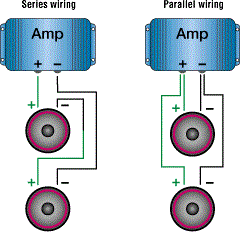
Y'all tin can run more than one speaker from a single amp aqueduct by wiring the speakers in series or in parallel. Series wiring volition enhance the load (resistance) that your amp sees, and parallel wiring will lower information technology. Be sure your amp is 2-ohm stable before wiring speakers in parallel.
back to elevation
Q: When should I apply a mono amplifier instead of a multichannel amplifier?
A: Mono, 1-channel amplifiers are for subwoofers. They're designed to work with a wide range of impedances, and have tone controls and filters specifically made to help reproduce bass. Because mono amps tend to be Class D amplifiers, they are a skilful choice for powering subwoofers — Grade D amplifiers have a loftier power-to-oestrus ratio and fantabulous efficiency, which are exactly what y'all desire when dealing with power-hungry depression frequency signals.
Most mono amplifiers are designed to run at 2 ohms, though some are even i-ohm stable. Multichannel amplifiers, on the other hand, are typically designed to work with ii-ohm loads on private channels but must encounter a minimum of 4 ohms when bridged. This is an of import difference when using your amp to power multiple subwoofers, because you lot won't be able to bridge your multichannel, four-ohm stable amp to ability multiple subs that nowadays less than a iv-ohm load. Instead, use a mono amplifier to power a 2-ohm load — two 4-ohm subwoofers, or two 2-ohm dual voice coil subwoofers, for example. You'll be able to push button your subwoofers with the mono amp's maximum power, without running at a dangerouly low impedance.
back to top
Q: What are the benefits of hooking upward two subwoofers to a mono amplifier? How would I wire them?
A: The benefits of hooking up two subs to a mono amplifier are the same every bit hooking up any other number of subs to a mono amp: you tin push the subs with more power at lower impedances. Because lower frequencies are less directional (i.east. it's more difficult for your ears to determine where low frequencies come from than highs), bass is often transmitted in mono. Mono here refers to a single channel (as opposed to stereo, or two channels), not one speaker.
Most mono amps have ii sets of speaker terminals for convenience of installation: if y'all are hooking upwards two subs to the amp and using large-gauge wire, information technology gives you a place to adhere the wires without having to trim them, actualization as if each subwoofer gets its own concluding. But in reality, these terminals are actually tied together inside the amp — both positives are going to the same place within the amp, equally are both negatives. If you are using more than two subs, so you simply apply parallel or serial wiring (or a combination) to get equally close to the minimum impedance of the amp every bit possible (see our subwoofer wiring diagrams for more than data).
dorsum to top
Q: What is "bridging" an amplifier?
A: : Bridging combines ii of an amplifier'southward channels into ane aqueduct, in order to go more power. For instance, a ii-channel amp that puts out 75 watts RMS per channel at 4 ohms may exist able to put out as much every bit 200 watts RMS at 4 ohms into ane channel when bridged, which could be great for running a subwoofer. In that location are no formulas for determining how much power y'all gain when you bridge an amp's channels — every amp is unlike. Most 2- and 4-aqueduct amplifiers have the capability of being bridged so they can conveniently be used in a multifariousness of situations and systems. Another example might be using a four-channel amp to bulldoze your left and right speakers with two of its channels, while driving a sub with its other ii channels bridged together, saving you the need to buy a split sub amp.
back to top
Q: Are there any problems in bridging an amp?
A: A disadvantage in bridging amplifiers is that y'all must be careful not to hook upwardly also low of an impedance load, or you lot could damage the amp. Amps that work with loads as low as 2 ohms per channel usually can safely drive loads only as depression as 4 ohms when bridged. The danger in driving an amplifier with an impedance load that's too low is that the amp could overheat and burn down out. Y'all should always check the bridged minimum impedance specification before connecting a bridged amplifier to a depression impedance sub or speaker system.
back to summit
Q: Can I span my mono amplifier?
A: No, yous cannot bridge a mono amp because there is nada to "span." Bridging means combining two amp channels together into one, in lodge to go more than power. If you only accept 1 channel, there's nothing to combine information technology with.
dorsum to acme
Q: I'd like to add an amplifier to my manufacturing plant car radio. What are my options?
A: Because information technology's a great mode to increase musical detail, dynamic range, and volume, calculation an amplifier is an extremely popular factory arrangement upgrade. And when the weather gets warm, even more people tell u.s. they're looking for a arrangement that can deliver roll-down-the-windows book.
In add-on to running power, ground, and a remote turn-on atomic number 82, your amp claw-upwards requires input signals. Your factory radio won't have RCA outputs to connect to your amp'southward inputs, so you'll get the signals from your vehicle's factory speaker wires. You'll want to get an amplifier that has loftier- or speaker-level input adequacy. But if you lot already take an amp and it doesn't take such a high level of input, you can use a line output converter to lower it to RCA-level.
If you're merely adding a subwoofer and subwoofer amp to a manufacturing plant system, you tap into the factory speaker wiring, either backside the radio or from the rear speakers, and utilise that speaker-level signal for your amp's input. Mono subwoofer amplifiers take 2 inputs, left and correct, and combine them internally to form the monaural signal used for subwoofers. For these and nearly other kinds of connections check out Posi-Products wire connectors — they make quick, easy, and reliable electric connections with no crimping, soldering, or messy tape.
To dilate your front and rear speakers with a 4-channel amplifier you cut the factory speaker wires and connect the ends coming from the radio to your amp's inputs and connect the ends going to the speakers to your amp's outputs. A user-friendly place to make these connections is behind the radio where all the vehicle'southward speaker wires are accessible in one location. If you plan on a high-powered arrangement using, say, a 100 watts per channel amp, all the same, and then y'all'll want to run new and thicker speaker wires directly to each speaker from your amp's output.
back to pinnacle
Q: How exercise I fine-tune my amplifier's gain and bass boost settings?
A: One of the terminal steps in any amplifier installation is to set its gain properly. Setting the gain matches your amplifier's input level with your receiver'due south output level, resulting in maximum distortion-gratuitous music and minimum background noise.
- Start with all the receiver'south EQ presets and tone controls off or set to flat. On your amp, undo all filters, set the bass heave to zip, and turn the gain down depression.
- Play some familiar music and turn up the receiver'southward volume until you hear the music start to distort, and so plow information technology down a little and then it plays clean. If you don't hear whatever distortion, even at full volume, set the receiver's volume to ¾ full.
- Slowly plow up your amp's gain until you hear the music beginning to distort, so turn it down a little so it plays clean once more.
- Lower the receiver's volume to a comfy listening level. Continue playing the familiar song over and over once more, as yous continue tuning your arrangement.
- On the receiver, adjust the EQ presets or tone controls to how you similar your music to sound.
- For a 2- or 4-channel full-range amplifier, engage the amp'south loftier-laissez passer filter and adapt it to remove the lowest bass notes from the full-range speakers. Those low notes would probably be the get-go ones to misconstrue through those speakers when you turn upward the volume later on. For sub amps, plow on the low-pass filter and remove anything that's not bass from the subwoofer's sound.
- The bass boost is another kind of EQ or tone control dedicated usually to one peculiarly depression note. Experiment carefully by applying it and listen to how information technology affects the tone of the bass and set it to where you similar it.
- Re-gear up the amp gain — turn the amp's gain down offset, so repeat steps two and three. Plow up the receiver's volume until y'all hear the music start to distort, so turn it down a little and so it plays make clean. If you don't hear any distortion, even at full volume, set the receiver's volume to ¾ full.
- Slowly plough up your amp's gain until you hear the music start to distort, then turn it down a piddling so it plays clean again.
Re-setting the gain (those last two steps) is important, to compensate for whatever EQ or boosts were applied, and then your amp's gain volition be set for exactly how yous mind to your music.
back to top
Q: What is the difference betwixt Acme Watts and RMS Watts?
A: RMS wattage is a measurement of power capacity used for comparing and matching components together. Peak wattage, often double the RMS value, is a clarification used by the marketing section of the amp'southward manufacturer to sell more amps. You should just use RMS ratings when comparison and matching gear.
back to peak

Source: https://www.crutchfield.com/ISEO-rgbtcspd/learn/car-amplifier-installation-questions.html
Posted by: pricesiand1988.blogspot.com
0 Response to "How Many Amps Does Amplifier Draw"
Post a Comment